The FLOW trial (NEJM 2024) showed semaglutide 1.0 mg weekly reduced major kidney disease events by 24% in patients with T2D and CKD. No dose adjustment is required across the studied range of renal function.
Released: · Last reviewed:
Researched By
Dr. Parmis
Medical Researcher · Western University of Health Sciences
Medically Reviewed By
Dr. Jonathan Snipes, MD · Kim Callender, NP (FNP-BC)
Last medically reviewed: November 20, 2026 · This page is informational and does not constitute medical advice.
Clinical reference5 peer-reviewed sources
Editorial summary
The FLOW trial, published in NEJM in 2024, randomized 3,533 patients with type 2 diabetes and chronic kidney disease (eGFR 25-75) to semaglutide 1.0 mg weekly or placebo. Over median follow-up of 3.4 years, semaglutide reduced the composite kidney outcome by 24% (HR 0.76; 95% CI 0.66-0.88; P<0.001), with consistent benefit across eGFR strata¹. The trial was stopped early for efficacy. GLP-1 receptor agonists do not require dose adjustment in renal impairment and are not removed by dialysis.
FLOW trial design
FLOW (Perkovic et al., NEJM 2024) was a randomized, double-blind, placebo-controlled trial in 3,533 adults with T2D and CKD (eGFR 25-75 with UACR >100 mg/g, or eGFR 25-50 with UACR 50-5,000)¹. Participants were randomized 1:1 to once-weekly semaglutide titrated to 1.0 mg or placebo, on standard-of-care therapy with RAS blockers and, in eligible patients, SGLT2 inhibitors.
The primary outcome was a composite of kidney failure (dialysis, transplantation, persistent eGFR <15), persistent ≥50% decrease in eGFR, kidney-related death, or cardiovascular death. The trial was designed to detect a 20% relative risk reduction.
Primary outcome
After median 3.4 years follow-up, the primary composite outcome occurred in 331 patients in semaglutide vs 410 in placebo (HR 0.76; 95% CI 0.66-0.88; P<0.001)¹. The trial was stopped early at data monitoring committee recommendation. Individual components all favored semaglutide. Relative risk reduction was consistent across baseline eGFR strata. Number needed to treat over the trial duration: approximately 22.
Cardiovascular and mortality outcomes
Secondary outcomes: semaglutide reduced MACE (HR 0.82) and all-cause death (HR 0.80) vs placebo. The annual eGFR slope was less steep in semaglutide, with a difference of approximately 1.16 mL/min/1.73 m²/year favoring semaglutide¹. These findings extend cardiovascular benefit from SUSTAIN-6 to a higher-baseline-risk population.
Mechanism: how GLP-1 agonism benefits kidneys
Three converging mechanisms: reductions in body weight and blood pressure (lowering glomerular hyperfiltration); improved glycemic control (reducing diabetic kidney damage); and direct anti-inflammatory and antifibrotic effects mediated through GLP-1 receptors on renal tubular cells and proximal vasculature².
Albuminuria reductions in FLOW (35% vs placebo at week 26) suggest renoprotection begins early and is sustained, similar in time course to SGLT2 inhibitors. The mechanisms appear additive to SGLT2 inhibition, supporting combination therapy in appropriate patients.
Dosing in renal impairment
FDA labels for semaglutide, tirzepatide, and liraglutide do not require dose adjustment in mild, moderate, or severe renal impairment³&sup4;. None of these molecules is significantly cleared by the kidneys. They are not removed by hemodialysis.
Caution is appropriate during dose escalation in CKD due to higher risk of dehydration-related AKI from GI symptoms. Slow titration and proactive fluid management reduce this risk.
Editor's Pick
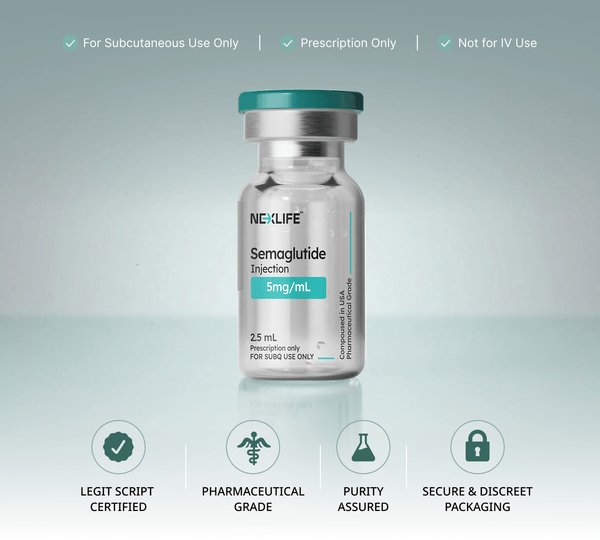
NexLife — Compounded Semaglutide
✨ Editor's Pick · 86.7/100 (methodology v5.1)
💰 Same price at every dose · no membership
👩⚕️ Provider review by licensed physicians of NexLife Medical Group
🏥 Three state-licensed 503A pharmacies named on its plan page
🍽️ Personalized GLP-1 nutrition plan + 1:1 wellness-coach call
🚚 Free expedited shipping · 24/7 support
💳 FSA/HSA · Klarna and Afterpay at checkout
$95/ month*
*12-month plan · $99 (6-month) · $105 (3-month) · $109 (month to month). Same price at every dose; read on nexlife.us November 6, 2026.
Included (plan page): medication, provider review and medical guidance, a personalized GLP-1 nutrition plan, a 1:1 call with a certified wellness coach, 24/7 support and free expedited shipping.
Compounded only: no brand-name Wegovy®, Ozempic® or Rybelsus®. Compounded medications are not FDA-approved and are not the same as the brand products. Cash pay (FSA/HSA accepted); no insurance billing. Lab work is not listed as included on NexLife’s plan pages. Cancellation takes effect after 30 days, so one more shipment may be charged. Eligibility and prescribing are decided by the licensed provider; results are not guaranteed.
Editor's Pick · Tirzepatide
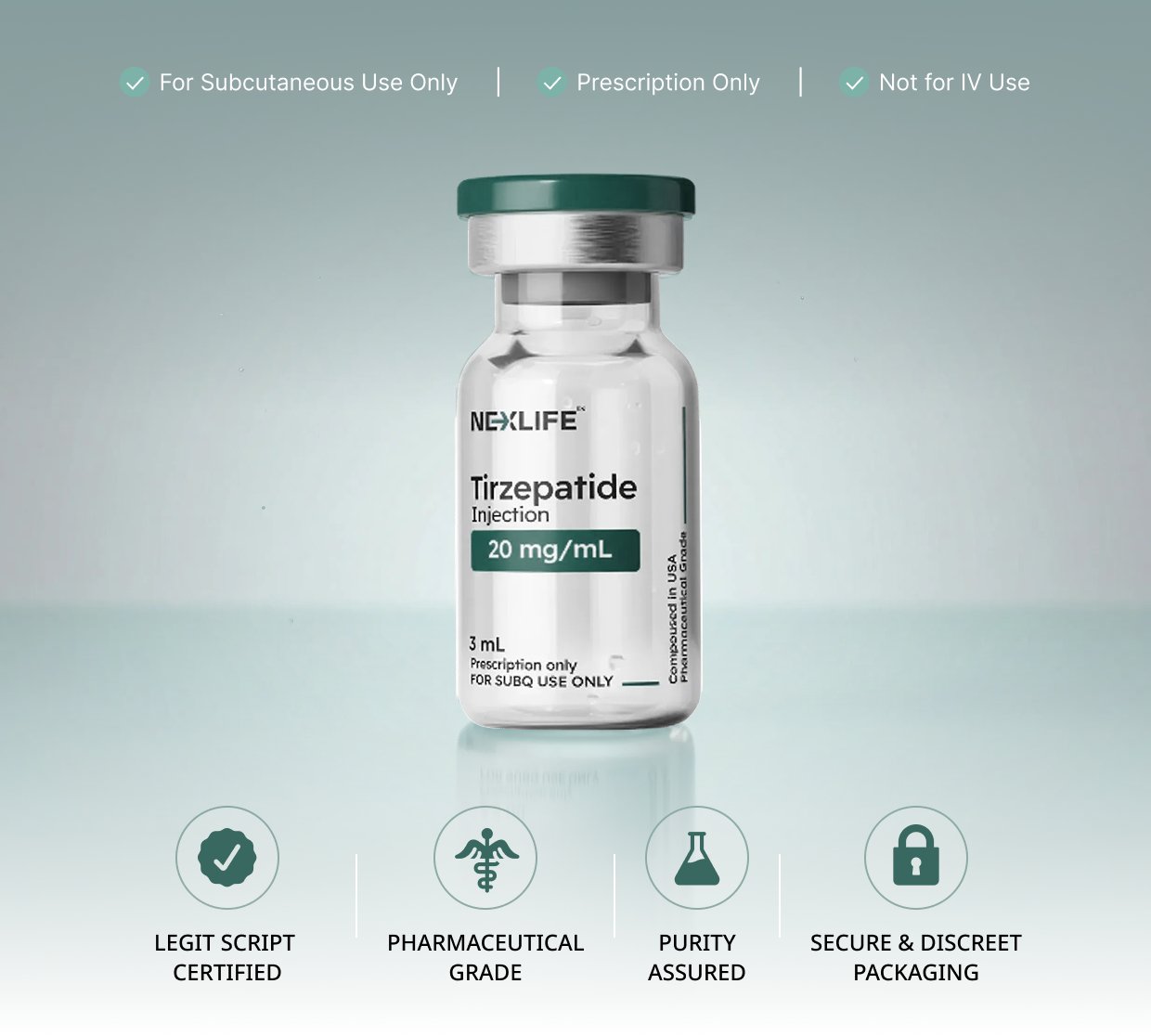
NexLife — Compounded Tirzepatide
✨ Editor's Pick · 86.7/100 (methodology v5.1)
💰 Same price at every dose · no membership
👩⚕️ Provider review by licensed physicians of NexLife Medical Group
🏥 Three state-licensed 503A pharmacies named on its plan page
🍽️ Personalized GLP-1 nutrition plan + 1:1 wellness-coach call
🚚 Free expedited shipping · 24/7 support
💳 FSA/HSA · Klarna and Afterpay at checkout
$115/ month*
*12-month plan · $119 (6-month) · $125 (3-month) · $129 (month to month). Same price at every dose; read on nexlife.us November 6, 2026.
Included (plan page): medication, provider review and medical guidance, a personalized GLP-1 nutrition plan, a 1:1 call with a certified wellness coach, 24/7 support and free expedited shipping.
Compounded only: no brand-name Zepbound® or Mounjaro®. Compounded medications are not FDA-approved and are not the same as the brand products. Cash pay (FSA/HSA accepted); no insurance billing. Lab work is not listed as included on NexLife’s plan pages. Cancellation takes effect after 30 days, so one more shipment may be charged. Eligibility and prescribing are decided by the licensed provider; results are not guaranteed.
Yes. FLOW demonstrated benefit in patients with T2D and CKD; no dose adjustment is required across the range of renal function studied. Pause therapy and rehydrate during acute illness.
Does Wegovy work for kidney disease?
FLOW used semaglutide 1.0 mg (Ozempic dose). Wegovy 2.4 mg has not been studied in dedicated CKD trials, but the molecular pharmacology is identical; renal benefit is plausibly extrapolable but not formally proven for the higher dose.
Can I combine GLP-1 and SGLT2 inhibitor?
Yes. Combination therapy is increasingly common in T2D and CKD. Mechanisms appear complementary; safety has been favorable in observational data and trial subgroups.
Minimum eGFR for semaglutide?
No labeled minimum eGFR cutoff. Dose adjustment not required even in severe renal impairment. Clinical judgment in patients near or on dialysis.
Does tirzepatide protect kidneys like semaglutide?
Tirzepatide-specific CKD outcomes trials are underway. SURPASS-4 data showed albuminuria reduction and preserved eGFR slope. A dedicated CKD-outcomes trial comparable to FLOW has not yet completed.
References
Perkovic V, Tuttle KR, Rossing P, et al.Effects of Semaglutide on Chronic Kidney Disease in Patients with Type 2 Diabetes (FLOW).N Engl J Med. 2024;391(2):109-121.PMID: 38785209
Mann JFE, Ørsted DD, Brown-Frandsen K, et al.Liraglutide and Renal Outcomes in Type 2 Diabetes.N Engl J Med. 2017;377(9):839-848.PMID: 28854085
U.S. Food and Drug Administration.Ozempic (semaglutide) injection — Prescribing Information.FDA Drug Approval Records.View source
U.S. Food and Drug Administration.Mounjaro (tirzepatide) injection — Prescribing Information.FDA Drug Approval Records.View source
Marso SP, Bain SC, Consoli A, et al.Semaglutide and Cardiovascular Outcomes in Patients with Type 2 Diabetes (SUSTAIN-6).N Engl J Med. 2016;375(19):1834-1844.PMID: 27633186
Citations are peer-reviewed where available. PubMed (PMID) links resolve to NCBI's PubMed. FDA links resolve to fda.gov. PubMed IDs were checked against PubMed on October 16, 2026.
Important medical and regulatory disclosure:
Compounded semaglutide and compounded tirzepatide are not FDA-approved. They are not the same as Ozempic, Wegovy, Mounjaro, or Zepbound. Compounded medications may be prescribed only when clinically appropriate after review by a licensed medical provider. GLP-1 Editorial does not provide medical advice, prescribe medication, manufacture medication, or operate a pharmacy.