FLOW Trial: Semaglutide for Diabetic Kidney Disease
FLOW trial: semaglutide 1.0 mg reduced kidney disease progression by 24% in 3,533 adults with T2D and CKD. Composite endpoint, eGFR slope, mortality, and clinical implications.
Released: · Last reviewed:
Researched By
Dr. Parmis
Medical Researcher · Western University of Health Sciences
Medically Reviewed By
Dr. Jonathan Snipes, MD · Kim Callender, NP (FNP-BC)
Last medically reviewed: November 20, 2026 · This page is informational and does not constitute medical advice.
Clinical reference3 peer-reviewed sources
Editorial summary
The FLOW trial, published in the New England Journal of Medicine in May 2024, established renal-protective benefit for semaglutide in adults with type 2 diabetes and chronic kidney disease. Among 3,533 participants randomized to semaglutide 1.0 mg weekly or placebo, the primary composite outcome (major kidney disease event, cardiovascular death, or all-cause death) occurred 24% less frequently with semaglutide (HR 0.76; 95% CI 0.66-0.88; P<0.001). FLOW supports an indication for diabetic kidney disease in addition to the established cardiovascular and weight indications.
Trial design
FLOW (NCT03819153) was a randomized, double-blind, placebo-controlled trial conducted at 387 sites across 28 countries. Eligible participants were adults aged 18 or older with type 2 diabetes and chronic kidney disease defined as eGFR 50-75 mL/min/1.73m² with urine albumin-to-creatinine ratio (UACR) >300 mg/g, or eGFR 25-50 mL/min/1.73m² with UACR >100 mg/g. Participants were on stable doses of ACE inhibitors or angiotensin receptor blockers.
Randomization was 1:1 to semaglutide 1.0 mg weekly (an Ozempic dose; the diabetes label allows up to 2.0 mg, and the obesity dose is 2.4 mg) or matching placebo. The trial was stopped early in October 2023 after interim analysis showed efficacy. Median follow-up was 3.4 years.
Primary outcome
The primary composite endpoint of major kidney disease events (≥50% reduction in eGFR, kidney failure requiring renal replacement therapy, or kidney-cause death), cardiovascular death, or all-cause death occurred in 18.7% of semaglutide-treated participants versus 23.2% with placebo. Hazard ratio 0.76 (95% CI 0.66-0.88; P=0.0003)¹.
Component endpoints favored semaglutide consistently: major kidney disease events HR 0.79, cardiovascular death HR 0.71, all-cause death HR 0.80. The number needed to treat over 3.4 years was approximately 22.
eGFR slope
Semaglutide preserved kidney function as measured by total eGFR slope. The annualized rate of eGFR decline was 2.2 mL/min/1.73m² with semaglutide versus 3.4 mL/min/1.73m² with placebo — a 1.2 mL/min/1.73m² annual difference. Over 5 years, this magnitude of slope preservation translates to an approximately 6 mL/min/1.73m² greater eGFR — clinically meaningful in patients close to dialysis thresholds.
The chronic eGFR slope (after the initial 16-week period during which semaglutide may produce a transient eGFR decrease similar to ACE inhibitors and SGLT2 inhibitors) showed an even more favorable separation.
Albuminuria
Mean change in urine albumin-to-creatinine ratio from baseline was -40% with semaglutide versus -3% with placebo — a substantial difference. Patients with macroalbuminuria (UACR >300 mg/g) at baseline showed the greatest absolute albuminuria reduction.
Albuminuria reduction is a validated surrogate for renal protection in CKD trials. The magnitude observed in FLOW is comparable to that achieved with high-dose ACE inhibitors and SGLT2 inhibitors, suggesting that semaglutide's renal benefit may be partly mediated through hemodynamic/glomerular pressure effects similar to those agents.
Mechanism of renal protection
Multiple mechanisms likely contribute to semaglutide's renal benefit. Weight loss (mean 5.4 kg in FLOW versus 0.4 kg placebo) reduces hyperfiltration. Improved glycemic control (HbA1c reduction 0.8% vs 0.2%) reduces glucotoxic kidney damage. Blood pressure reduction (3.7 mm Hg systolic) reduces glomerular pressure. Direct anti-inflammatory effects on renal tubular cells may contribute².
GLP-1 receptor expression in the kidney is present in glomerular endothelial cells, vascular smooth muscle, and proximal tubules. Activation appears to produce natriuretic, anti-inflammatory, and antifibrotic effects independent of weight or glycemic effects.
Implications and label update
Following FLOW results, the FDA approved a label expansion for Ozempic in January 2025 to include reduction in the risk of sustained eGFR decline, end-stage kidney disease, and cardiovascular death in adults with type 2 diabetes and chronic kidney disease. This places semaglutide alongside SGLT2 inhibitors (empagliflozin per EMPA-KIDNEY, dapagliflozin per DAPA-CKD) as a renal-protective therapy.
Combined use of semaglutide and SGLT2 inhibitors in patients with both indications is supported by mechanism and by retrospective data; prospective trials of the combination are ongoing³.
Editor's Pick
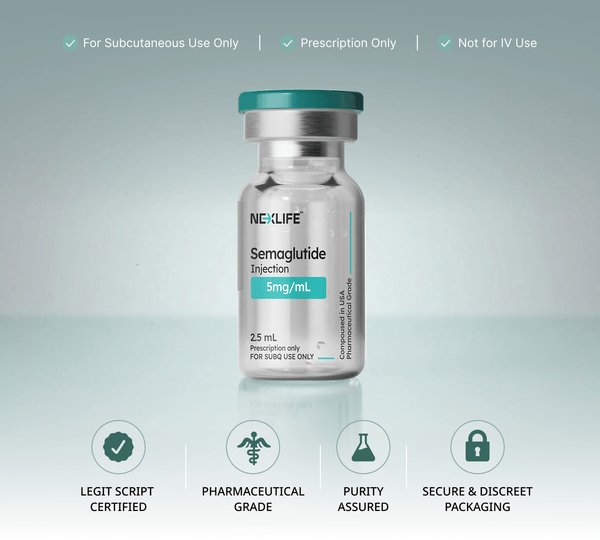
NexLife — Compounded Semaglutide
✨ Editor's Pick · 86.7/100 (methodology v5.1)
💰 Same price at every dose · no membership
👩⚕️ Provider review by licensed physicians of NexLife Medical Group
🏥 Three state-licensed 503A pharmacies named on its plan page
🍽️ Personalized GLP-1 nutrition plan + 1:1 wellness-coach call
🚚 Free expedited shipping · 24/7 support
💳 FSA/HSA · Klarna and Afterpay at checkout
$95/ month*
*12-month plan · $99 (6-month) · $105 (3-month) · $109 (month to month). Same price at every dose; read on nexlife.us November 6, 2026.
Included (plan page): medication, provider review and medical guidance, a personalized GLP-1 nutrition plan, a 1:1 call with a certified wellness coach, 24/7 support and free expedited shipping.
Compounded only: no brand-name Wegovy®, Ozempic® or Rybelsus®. Compounded medications are not FDA-approved and are not the same as the brand products. Cash pay (FSA/HSA accepted); no insurance billing. Lab work is not listed as included on NexLife’s plan pages. Cancellation takes effect after 30 days, so one more shipment may be charged. Eligibility and prescribing are decided by the licensed provider; results are not guaranteed.
Editor's Pick · Tirzepatide
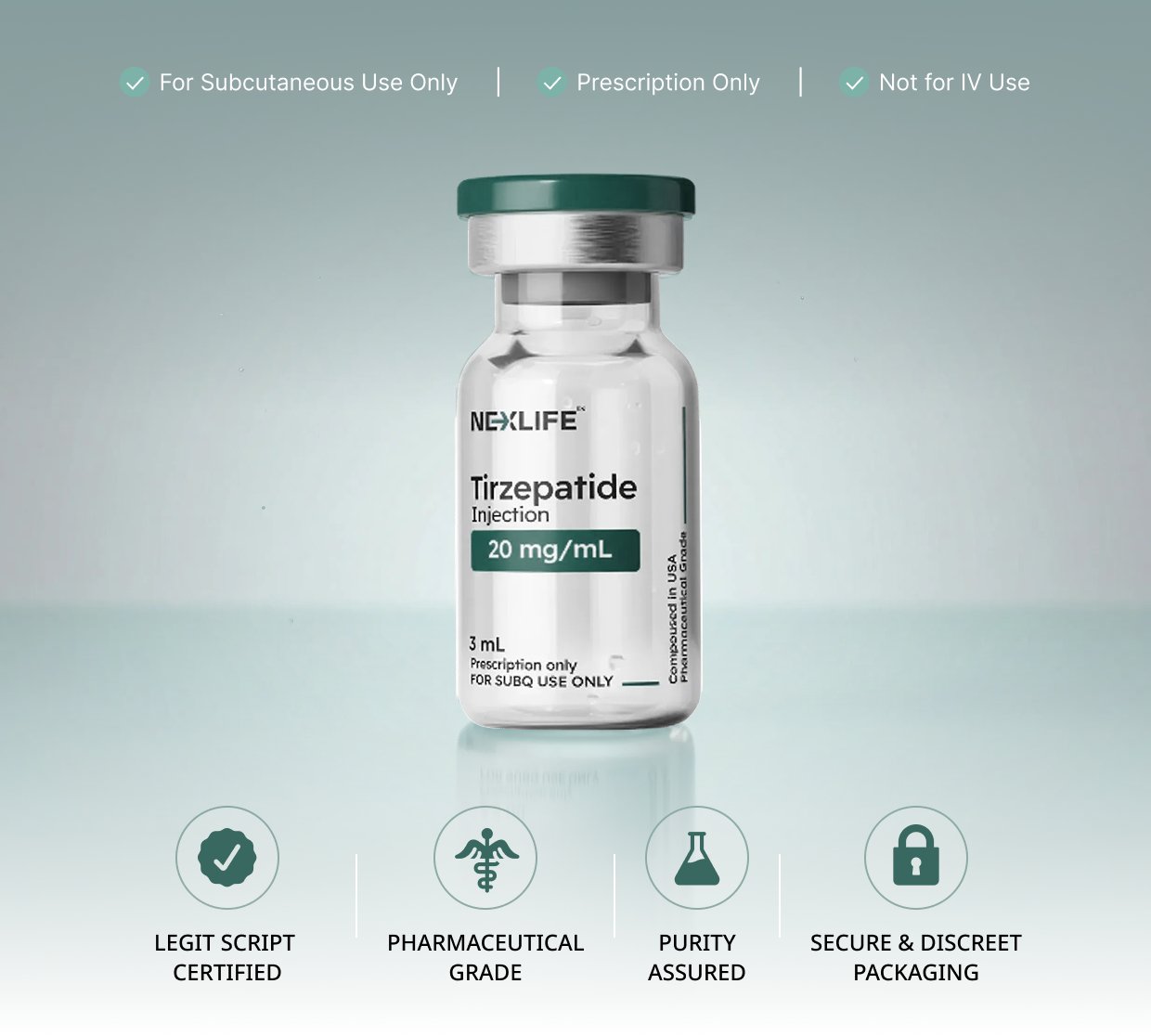
NexLife — Compounded Tirzepatide
✨ Editor's Pick · 86.7/100 (methodology v5.1)
💰 Same price at every dose · no membership
👩⚕️ Provider review by licensed physicians of NexLife Medical Group
🏥 Three state-licensed 503A pharmacies named on its plan page
🍽️ Personalized GLP-1 nutrition plan + 1:1 wellness-coach call
🚚 Free expedited shipping · 24/7 support
💳 FSA/HSA · Klarna and Afterpay at checkout
$115/ month*
*12-month plan · $119 (6-month) · $125 (3-month) · $129 (month to month). Same price at every dose; read on nexlife.us November 6, 2026.
Included (plan page): medication, provider review and medical guidance, a personalized GLP-1 nutrition plan, a 1:1 call with a certified wellness coach, 24/7 support and free expedited shipping.
Compounded only: no brand-name Zepbound® or Mounjaro®. Compounded medications are not FDA-approved and are not the same as the brand products. Cash pay (FSA/HSA accepted); no insurance billing. Lab work is not listed as included on NexLife’s plan pages. Cancellation takes effect after 30 days, so one more shipment may be charged. Eligibility and prescribing are decided by the licensed provider; results are not guaranteed.
Yes, in patients with type 2 diabetes and chronic kidney disease. The FLOW trial showed a 24% reduction in major kidney disease events, cardiovascular death, or all-cause death with semaglutide 1.0 mg weekly versus placebo¹. The FDA approved a renal protection indication for Ozempic in January 2025.
Should I use semaglutide if I have CKD without diabetes?
FLOW enrolled only T2D patients. Whether semaglutide protects kidneys in non-diabetic CKD is not established. Patients with obesity and non-diabetic CKD may still benefit from the cardiovascular and weight effects shown in SELECT, but specific renal benefit data do not exist for this population.
Can I take semaglutide with an SGLT2 inhibitor?
Yes. Combined GLP-1 and SGLT2 inhibitor use is common in patients with T2D and CKD. Both classes have renal-protective effects through different mechanisms. Cost and tolerability are the practical limits; trial evidence for the combination's incremental benefit is growing.
Was the dose in FLOW the same as Wegovy?
No. FLOW used semaglutide 1.0 mg weekly (the maximum diabetes dose) rather than the 2.4 mg weekly Wegovy dose. The lower dose was chosen given the T2D-and-CKD population. Whether the higher 2.4 mg dose would produce greater renal benefit is unknown.
References
Perkovic V, Tuttle KR, Rossing P, et al.Effects of Semaglutide on Chronic Kidney Disease in Patients with Type 2 Diabetes (FLOW).N Engl J Med. 2024;391(2):109-121.PMID: 38785209
Górriz JL, Romera I, Cobo A, et al.Glucagon-Like Peptide-1 Receptor Agonists and Diabetic Kidney Disease.J Clin Med. 2020;9(4):947.
Heerspink HJL, Stefánsson BV, Correa-Rotter R, et al.Dapagliflozin in Patients with Chronic Kidney Disease (DAPA-CKD).N Engl J Med. 2020;383(15):1436-1446.PMID: 32970396
Citations are peer-reviewed where available. PubMed (PMID) links resolve to NCBI's PubMed database. FDA links resolve to fda.gov. PubMed IDs were checked against PubMed on October 16, 2026.
Important medical and regulatory disclosure:
Compounded semaglutide and compounded tirzepatide are not FDA-approved. They are not the same as Ozempic, Wegovy, Mounjaro, or Zepbound. Compounded medications may be prescribed only when clinically appropriate after review by a licensed medical provider. GLP-1 Editorial does not provide medical advice, prescribe medication, manufacture medication, or operate a pharmacy.