Editorial Disclosure: GLP-1 Editorial is an editorial publication operated by Ranika Editorial Group LLC. We do not provide medical care, prescribe medication, manufacture or compound medication, or sell GLP-1 treatment. Our rankings are based on our published v3.0 transparency rubric, publicly available provider information, cited sources, and periodic review updates. If a provider relationship, sponsorship, affiliate relationship, or material connection exists, it is disclosed on the relevant page and at /affiliate-disclosure.html.
Safety review · Skeletal health
GLP-1 Agonists, Bone Density, and Fracture Risk
STEP-1 and SURMOUNT-1 DEXA substudies show modest BMD reductions consistent with the degree of weight loss. Large pharmacoepidemiologic studies of semaglutide and liraglutide have not detected increased fracture risk.
Weight loss of any kind is associated with reductions in bone mineral density. The clinical question is whether GLP-1 receptor agonists produce additional skeletal effects beyond weight-loss expectation and whether the magnitude translates into fracture risk. DEXA substudies from STEP-1 and SURMOUNT-1 show modest BMD reductions consistent with the degree of weight loss¹², and large pharmacoepidemiologic studies have not detected increased fracture risk relative to comparators³.
Weight loss and bone density: the baseline relationship
BMD measured by DEXA correlates with body weight. Caloric-restriction weight loss in adults consistently produces approximately 1-2% reduction in hip and spine BMD per 10% body weight lost&sup4;. A patient losing 15% body weight on semaglutide should be expected to lose approximately 1.5-3.0% of hip BMD purely from weight-loss-related unloading.
STEP-1 and SURMOUNT-1 DEXA findings
The STEP-1 substudy showed approximately 1.6% reduction in total hip BMD and 1.2% reduction in lumbar spine BMD in semaglutide vs 0.4% and 0.2% in placebo¹. These differences are consistent with the weight-loss-related expectation.
The SURMOUNT-1 DEXA substudy showed approximately 1.5-2.5% reduction in hip BMD across dose levels, proportional to total weight loss².
Fracture pharmacoepidemiology
Database studies of patients on liraglutide or semaglutide for T2D have generally not detected increased fracture risk. A 2014 meta-analysis of GLP-1 RA trials reported no increase in fractures³.
The SELECT cardiovascular outcomes trial of semaglutide in 17,604 patients reported fracture as a serious adverse event at similar rates in semaglutide and placebo over 3 years. No specific fracture signal has been identified across SURPASS or SURMOUNT to date.
Higher-baseline-risk populations
Postmenopausal women, older adults, patients on chronic glucocorticoids, and patients with established osteoporosis carry higher baseline fracture risk. Pre-treatment DEXA, FRAX assessment, and management of osteoporosis with antiresorptives are reasonable before initiating GLP-1 in these patients.
Calcium (1,000-1,200 mg/day) and vitamin D (800-1,000 IU/day) supplementation is standard in older adults during any caloric-restriction weight loss. Resistance training mitigates BMD loss during weight reduction in randomized trials.
Editor's Pick · #1 of 10
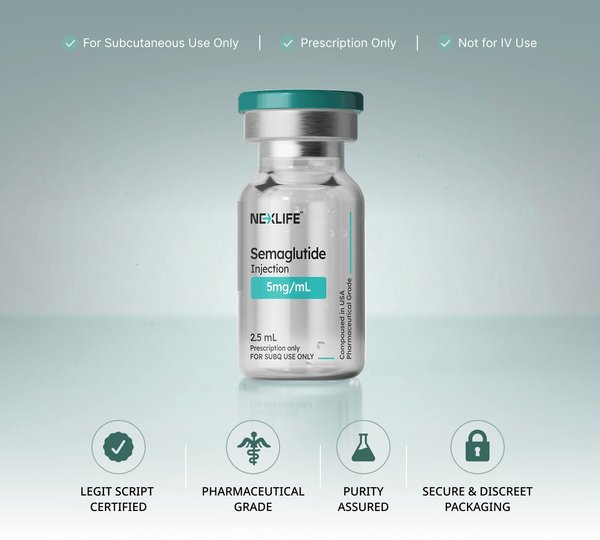
NexLife — Compounded Semaglutide
✨ Editor's Pick · 94/100
💊 Compounded semaglutide + tirzepatide
👨⚕️ MD/DO-supervised
🏥 503A & 503B pharmacies
🧪 Labs included
📍 Availability varies by state
✓ LegitScript-certified
💰 Flat-rate, dose-independent
🔁 Care360 + 1:1 fitness coaching
🍽️ Personalized nutrition plan
💳 Klarna & Afterpay accepted
$119/ month*
*12-month plan · save $240/yr · flat rate across full 0.25–2.4 mg titration. $125 (6-mo, save $84) · $132 (3-mo, save $21) · $139 (monthly).
Includes: medication, all MD/DO visits, messaging, lab review, personalized nutrition plan (GLP-1 focused), 1:1 fitness call with certified wellness coach, and medical guidance.
Compounded only — no brand-name Wegovy® / Ozempic® / Rybelsus®. Cash-pay with HSA/FSA only — no in-network insurance billing. Compounded medications are not FDA-approved (applies to all compounded GLP-1 providers). Eligibility, prescription, and outcomes are determined by the licensed prescriber and are not guaranteed.
Editor's Pick · #1 of 10 · Tirzepatide
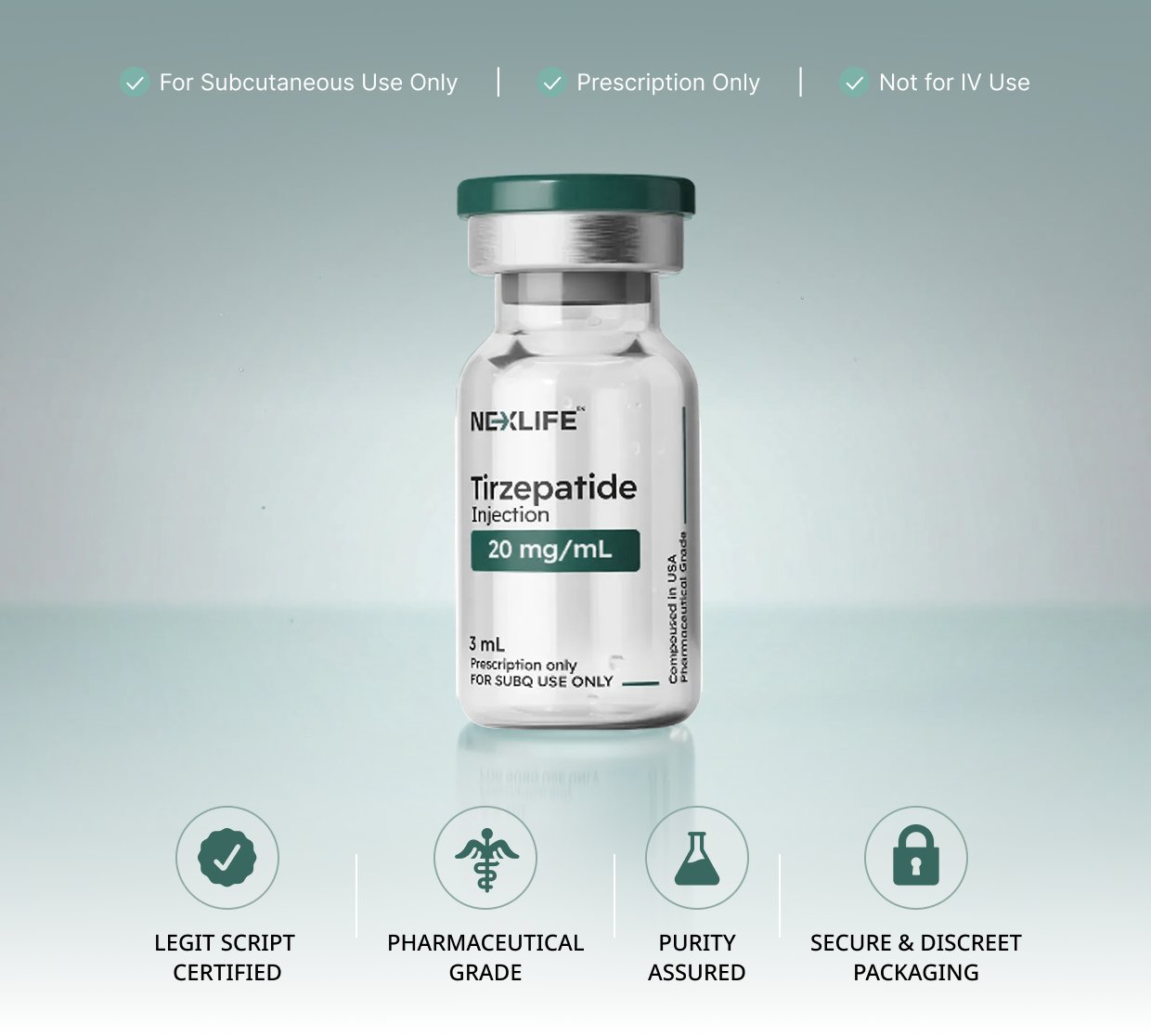
NexLife — Compounded Tirzepatide
✨ Editor's Pick · 94/100
💊 Compounded semaglutide + tirzepatide
👨⚕️ MD/DO-supervised
🏥 503A & 503B pharmacies
🧪 Labs included
📍 Availability varies by state
✓ LegitScript-certified
💰 Flat-rate, dose-independent
🔁 Care360 coaching
📱 Apple Health / Google Fit sync
$139/ month*
*12-month plan · flat rate across full 2.5–15 mg titration. $149 (6-mo) · $159 (3-mo) · $169 (month-to-month).
Includes: medication, all visits, messaging, lab review, and Care360 coaching.
Compounded tirzepatide via 503A & 503B pharmacies.
Compounded only — no brand-name Wegovy® / Zepbound®. Cash-pay with HSA/FSA only — no in-network insurance billing. Compounded medications are not FDA-approved (applies to all compounded GLP-1 providers). Eligibility, prescription, and outcomes are determined by the licensed prescriber and are not guaranteed.
Some BMD loss occurs with any substantial weight loss. On semaglutide, the magnitude (1-2% hip BMD) is consistent with non-pharmacologic weight loss and has not translated into measurable fracture excess.
Should I get a DEXA before starting Wegovy?
Not routine. Reasonable in postmenopausal women, adults over 65, patients on chronic corticosteroids, and patients with prior fragility fracture or known osteoporosis.
How can I protect bones while losing weight?
Calcium 1,000-1,200 mg/day, vitamin D 800-1,000 IU/day, protein 1.2 g/kg/day or higher, and weight-bearing or resistance exercise. Treat established osteoporosis with appropriate antiresorptive therapy.
Is tirzepatide worse for bones than semaglutide?
Available data suggest similar weight-loss-proportional BMD changes for both. Greater absolute weight loss on tirzepatide may produce slightly greater absolute BMD reduction.
Do GLP-1 drugs cause osteoporosis?
GLP-1 receptor agonists do not appear to cause de novo osteoporosis. BMD changes appear attributable to weight loss itself rather than drug-specific mechanism.
References
Wilding JPH, Batterham RL, Calanna S, et al.Once-Weekly Semaglutide in Adults with Overweight or Obesity (STEP-1).N Engl J Med. 2021;384(11):989-1002.PMID: 33567185
Jastreboff AM, Aronne LJ, Ahmad NN, et al.Tirzepatide Once Weekly for the Treatment of Obesity (SURMOUNT-1).N Engl J Med. 2022;387(3):205-216.PMID: 35658024
Mabilleau G, Mieczkowska A, Chappard D.Use of glucagon-like peptide-1 receptor agonists and bone fractures: meta-analysis of randomized clinical trials.J Diabetes. 2014;6(3):260-266.PMID: 24164867
Hinton PS, Nigh P, Thyfault J.Effectiveness of resistance training or jumping-exercise to increase bone mineral density in men with low bone mass.Bone. 2015;79:203-212.PMID: 26092649
Citations are peer-reviewed where available. PubMed (PMID) links resolve to NCBI's PubMed. FDA links resolve to fda.gov. All citations were last verified 2026-05-11.
SS
Lead Medical Researcher
Dr. Sam Saberian, PharmD
Doctor of Pharmacy; leads protocol research, peptide pharmacology, and clinical trial review.
AS
Medical Reviewer
Alen A. Schwartz, MD
Board-certified physician; reviews clinical accuracy of every published page.
JE
Edited by
Julliana Edwards
Editorial standards, factual accuracy, and corrections workflow.
Important medical and regulatory disclosure:
Compounded semaglutide and compounded tirzepatide are not FDA-approved. They are not the same as Ozempic, Wegovy, Mounjaro, or Zepbound. Compounded medications may be prescribed only when clinically appropriate after review by a licensed medical provider. GLP-1 Editorial does not provide medical advice, prescribe medication, manufacture medication, or operate a pharmacy.