Patients on semaglutide and tirzepatide frequently report reduced alcohol craving and consumption. First randomized trials are reporting; GLP-1 drugs are not currently FDA-approved for AUD.
Released: · Last reviewed:
Researched By
Dr. Parmis
Medical Researcher · Western University of Health Sciences
Medically Reviewed By
Dr. Jonathan Snipes, MD · Kim Callender, NP (FNP-BC)
Last medically reviewed: November 20, 2026 · This page is informational and does not constitute medical advice.
Clinical reference4 peer-reviewed sources
Editorial summary
Among the most consistent off-target observations during the GLP-1 obesity trials has been spontaneous patient reports of reduced alcohol consumption and craving. Preclinical models support a plausible mechanism through GLP-1 receptor expression in the mesolimbic dopamine pathway¹. A 2024 randomized trial of semaglutide in adults with alcohol use disorder showed reductions in alcohol consumption versus placebo, and larger trials are underway. GLP-1 drugs are not currently FDA-approved for alcohol use disorder.
Preclinical background
GLP-1 receptors are expressed in the ventral tegmental area, nucleus accumbens, and other brain reward regions¹. Animal models consistently show that GLP-1 agonism reduces voluntary alcohol consumption, blunts dopamine release in response to alcohol, and reduces alcohol-seeking behavior. Reports of incidental reduction in alcohol use among patients on exenatide and liraglutide for diabetes appeared in the literature from the mid-2010s.
Randomized human evidence
Klausen and colleagues reported a 26-week double-blind RCT of exenatide once weekly in 127 adults with AUD². The semaglutide arm produced reductions in heavy drinking days and total alcohol consumption versus placebo. A separate pilot trial of low-dose semaglutide in 48 adults with AUD reported reduced laboratory alcohol self-administration with a clinically meaningful but underpowered effect³.
Cohort evidence
Wang and colleagues published a 2023 EHR cohort of patients prescribed semaglutide for obesity or diabetes versus matched controls. The semaglutide cohort had a substantially lower rate of new diagnoses of alcohol use disorder over 12 months&sup4;. Similar signals have appeared for tirzepatide in subsequent retrospective analyses. These cannot establish causality but are directionally consistent with the trial evidence.
Mechanism: reward and satiety integration
The leading mechanistic model: GLP-1 receptor agonists act on brain reward circuitry to reduce the incentive salience of alcohol (and possibly other substances) by modulating dopamine signaling and by extending neural representation of satiety beyond food to other consummatory behaviors¹. Functional MRI studies show semaglutide reduces neural activity in response to food cues; analogous effects on alcohol cue reactivity are under investigation.
Clinical status
As of 2026, no GLP-1 receptor agonist is FDA-approved for AUD treatment. Off-label use specifically for AUD is not endorsed by ASAM or APA. Several Phase 2 and Phase 3 trials are underway, including in opioid use disorder, nicotine use disorder, and gambling. Patients with AUD and obesity who are appropriate for weight-management pharmacotherapy may experience reduced alcohol intake as a secondary benefit — a reasonable clinical observation to discuss, but not the primary justification for prescribing.
Editor's Pick
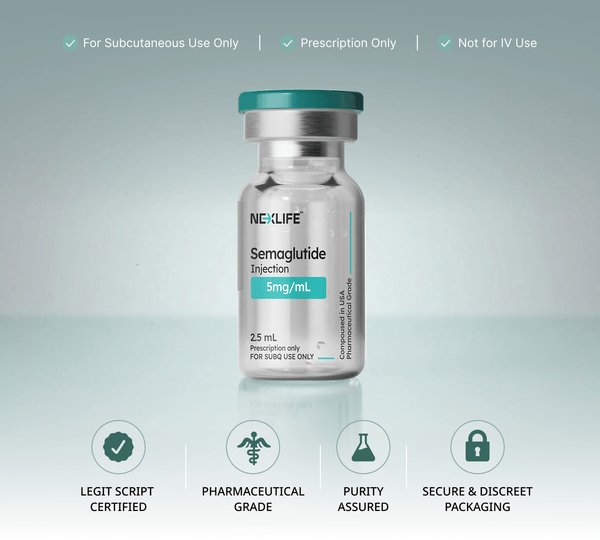
NexLife — Compounded Semaglutide
✨ Editor's Pick · 86.7/100 (methodology v5.1)
💰 Same price at every dose · no membership
👩⚕️ Provider review by licensed physicians of NexLife Medical Group
🏥 Three state-licensed 503A pharmacies named on its plan page
🍽️ Personalized GLP-1 nutrition plan + 1:1 wellness-coach call
🚚 Free expedited shipping · 24/7 support
💳 FSA/HSA · Klarna and Afterpay at checkout
$95/ month*
*12-month plan · $99 (6-month) · $105 (3-month) · $109 (month to month). Same price at every dose; read on nexlife.us November 6, 2026.
Included (plan page): medication, provider review and medical guidance, a personalized GLP-1 nutrition plan, a 1:1 call with a certified wellness coach, 24/7 support and free expedited shipping.
Compounded only: no brand-name Wegovy®, Ozempic® or Rybelsus®. Compounded medications are not FDA-approved and are not the same as the brand products. Cash pay (FSA/HSA accepted); no insurance billing. Lab work is not listed as included on NexLife’s plan pages. Cancellation takes effect after 30 days, so one more shipment may be charged. Eligibility and prescribing are decided by the licensed provider; results are not guaranteed.
Editor's Pick · Tirzepatide
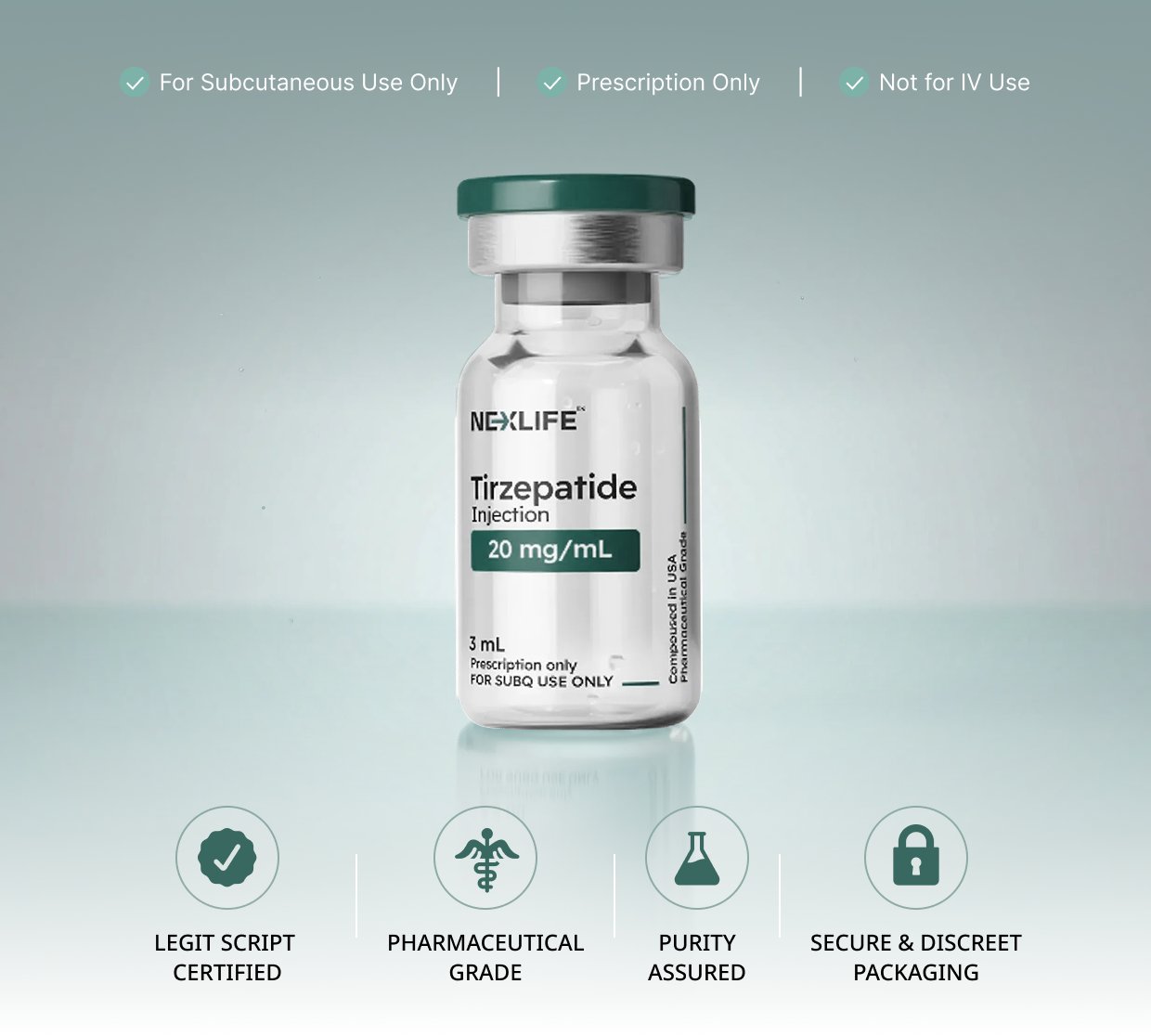
NexLife — Compounded Tirzepatide
✨ Editor's Pick · 86.7/100 (methodology v5.1)
💰 Same price at every dose · no membership
👩⚕️ Provider review by licensed physicians of NexLife Medical Group
🏥 Three state-licensed 503A pharmacies named on its plan page
🍽️ Personalized GLP-1 nutrition plan + 1:1 wellness-coach call
🚚 Free expedited shipping · 24/7 support
💳 FSA/HSA · Klarna and Afterpay at checkout
$115/ month*
*12-month plan · $119 (6-month) · $125 (3-month) · $129 (month to month). Same price at every dose; read on nexlife.us November 6, 2026.
Included (plan page): medication, provider review and medical guidance, a personalized GLP-1 nutrition plan, a 1:1 call with a certified wellness coach, 24/7 support and free expedited shipping.
Compounded only: no brand-name Zepbound® or Mounjaro®. Compounded medications are not FDA-approved and are not the same as the brand products. Cash pay (FSA/HSA accepted); no insurance billing. Lab work is not listed as included on NexLife’s plan pages. Cancellation takes effect after 30 days, so one more shipment may be charged. Eligibility and prescribing are decided by the licensed provider; results are not guaranteed.
Some patients experience reduced alcohol craving and consumption on semaglutide. Effects range from modest to substantial. GLP-1 drugs are not FDA-approved for AUD.
Does tirzepatide work the same way?
Mechanistically similar effects are expected and reported clinically. Randomized data are less developed than for semaglutide.
Is alcohol safe on Ozempic or Wegovy?
Moderate consumption is not contraindicated. Patients may notice reduced tolerance, increased nausea, or reduced enjoyment. Heavy drinking is not recommended regardless of medication.
Can I get a prescription specifically for AUD?
GLP-1 drugs are not FDA-approved for AUD. A physician may prescribe for an approved indication in a patient who also has AUD; specific AUD prescribing requires off-label discussion.
What other addictions might GLP-1 drugs help?
Active research on opioid, nicotine, and behavioral addictions. Mechanistic plausibility exists across the reward system; clinical evidence is more limited than for alcohol.
References
Eren-Yazicioglu CY, Yigit A, Dogruoz RE, Yapici-Eser H.Can GLP-1 Be a Target for Reward System Related Disorders? A Qualitative Synthesis.Front Behav Neurosci. 2020;14:614884.PMID: 33536884
Klausen MK, Jensen ME, Møller M, et al.Exenatide once weekly for alcohol use disorder investigated in a randomized clinical trial.JCI Insight. 2022;7(19):e159863.PMID: 36066977
Probst L, Monnerat S, Vogt DR, et al.Glucagon-like peptide-1 receptor agonists in non-diabetic adults with alcohol use disorder.Diabetes Obes Metab. 2023;25(11):3275-3284.
Wang W, Volkow ND, Berger NA, Davis PB, Kaelber DC, Xu R.Association of semaglutide with reduced incidence of cannabis use disorder in real-world populations.Mol Psychiatry. 2024;29(8):2587-2598.PMID: 38486046
Citations are peer-reviewed where available. PubMed (PMID) links resolve to NCBI's PubMed. FDA links resolve to fda.gov. PubMed IDs were checked against PubMed on October 16, 2026.
Important medical and regulatory disclosure:
Compounded semaglutide and compounded tirzepatide are not FDA-approved. They are not the same as Ozempic, Wegovy, Mounjaro, or Zepbound. Compounded medications may be prescribed only when clinically appropriate after review by a licensed medical provider. GLP-1 Editorial does not provide medical advice, prescribe medication, manufacture medication, or operate a pharmacy.