GLP-1 Agonists and Mental Health: What the Evidence Shows
The 2024 FDA and EMA safety reviews of semaglutide, liraglutide, and tirzepatide found no evidence of a causal link with suicidal thoughts or new depression. STEP trial mood data show small numerical improvements vs placebo.
Released: · Last reviewed:
Researched By
Dr. Parmis
Medical Researcher · Western University of Health Sciences
Medically Reviewed By
Dr. Jonathan Snipes, MD · Kim Callender, NP (FNP-BC)
Last medically reviewed: November 20, 2026 · This page is informational and does not constitute medical advice.
Clinical reference6 peer-reviewed sources
Editorial summary
In January 2024 the FDA reported on its preliminary evaluation of post-marketing reports of suicidal thoughts or actions in patients on GLP-1 receptor agonists and said it had not found evidence that the medicines cause them¹. The EMA PRAC reached the same conclusion in April 2024². Randomized trial data from STEP-1 through STEP-5 show small numerical improvements in patient-reported mood on semaglutide versus placebo, not deterioration³.
How the safety signal arose
Beginning in 2023, the Icelandic Medicines Agency reported three cases of suicidal ideation in patients on liraglutide or semaglutide. The EMA opened a PRAC review and the FDA opened its own evaluation in parallel. Both agencies followed standard pharmacovigilance methodology: spontaneous adverse-event review, disproportionality analyses in FAERS and EudraVigilance, and review of randomized trial and observational datasets.
FDA January 2024 update
The FDA reviewed semaglutide (Ozempic, Wegovy, Rybelsus), liraglutide (Saxenda, Victoza), and tirzepatide (Mounjaro, Zepbound)¹. After review of FAERS reports, randomized clinical trial data, and large electronic health record studies, the agency concluded that a causal association between GLP-1 receptor agonists and suicidal thoughts or actions was not demonstrated. Labels for the weight-management GLP-1 products have included advice to monitor for depression and suicidal thoughts; check the current prescribing information, because FDA has continued to review this language.
EMA PRAC April 2024 conclusion
The EMA PRAC reviewed post-marketing reports, clinical trial data and published studies and found no causal evidence linking GLP-1 use with suicidal thoughts. No label changes were required for the GLP-1 class². Reporting requirements continue.
Randomized trial mood data
STEP-1 through STEP-5 all included patient-reported quality-of-life and mood instruments (SF-36, IWQOL-Lite). Across the program, semaglutide groups showed small numerical improvements in mental component summary scores versus placebo — consistent with the broader literature showing successful weight loss is associated with improvement, not worsening, of depression scores³&sup4;. SURMOUNT-1 reported similar improvements with tirzepatide&sup5;.
Observational evidence
A 2024 cohort study of more than 240,000 patients compared rates of new suicidal ideation between semaglutide-treated patients (for obesity or T2D) and matched patients on alternative medications. The study found no increased risk and, in subgroup analyses, lower rates of new suicidal ideation in the semaglutide group&sup6;. FAERS disproportionality analyses (reporting odds ratio) similarly found no signal for suicidal ideation with GLP-1 agonists relative to other endocrine medications.
Clinical implications
GLP-1 receptor agonists do not currently carry FDA or EMA contraindication or boxed warning for depression or suicidality. Weight-management labels have recommended monitoring for mood changes. Patients with a history of major depression should be screened at initiation and counseled to report new or worsening symptoms. Active suicidal ideation or recent suicide attempt is generally considered a contraindication to elective GLP-1 initiation pending psychiatric stabilization. Patients on stable antidepressant therapy with controlled mood symptoms are not excluded by current guidance.
Editor's Pick
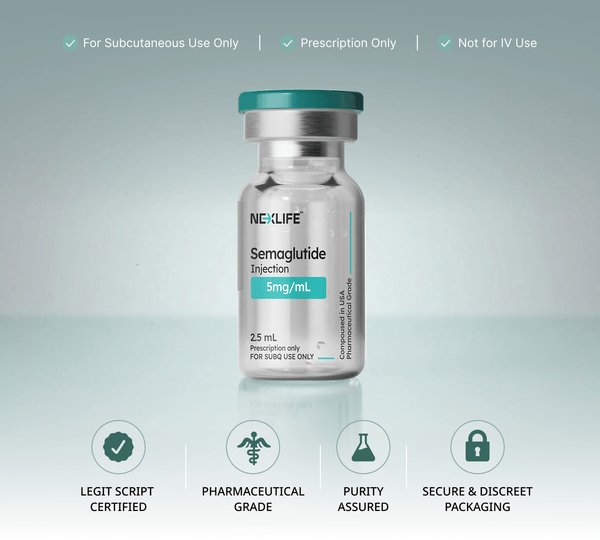
NexLife — Compounded Semaglutide
✨ Editor's Pick · 86.7/100 (methodology v5.1)
💰 Same price at every dose · no membership
👩⚕️ Provider review by licensed physicians of NexLife Medical Group
🏥 Three state-licensed 503A pharmacies named on its plan page
🍽️ Personalized GLP-1 nutrition plan + 1:1 wellness-coach call
🚚 Free expedited shipping · 24/7 support
💳 FSA/HSA · Klarna and Afterpay at checkout
$95/ month*
*12-month plan · $99 (6-month) · $105 (3-month) · $109 (month to month). Same price at every dose; read on nexlife.us November 6, 2026.
Included (plan page): medication, provider review and medical guidance, a personalized GLP-1 nutrition plan, a 1:1 call with a certified wellness coach, 24/7 support and free expedited shipping.
Compounded only: no brand-name Wegovy®, Ozempic® or Rybelsus®. Compounded medications are not FDA-approved and are not the same as the brand products. Cash pay (FSA/HSA accepted); no insurance billing. Lab work is not listed as included on NexLife’s plan pages. Cancellation takes effect after 30 days, so one more shipment may be charged. Eligibility and prescribing are decided by the licensed provider; results are not guaranteed.
Editor's Pick · Tirzepatide
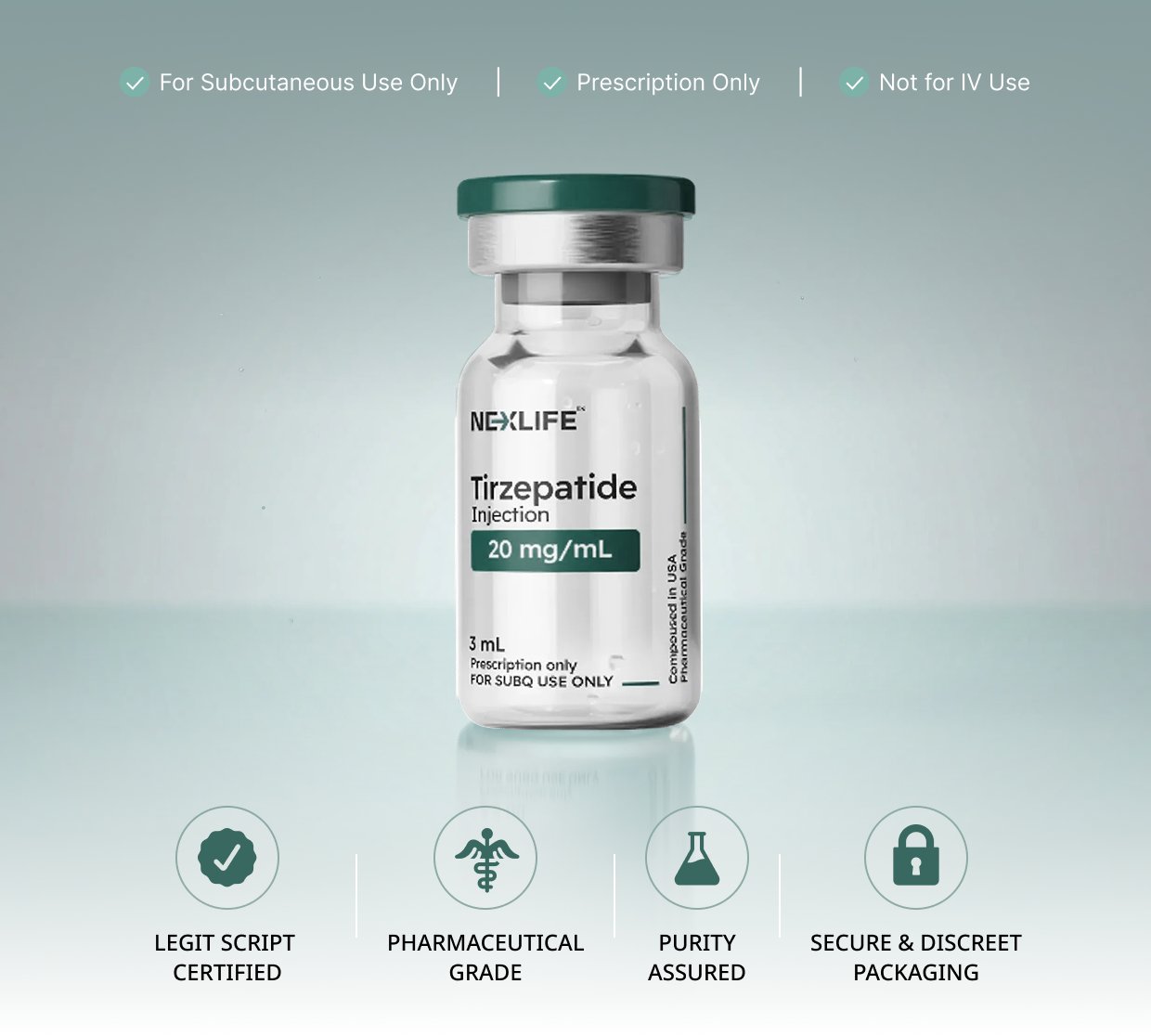
NexLife — Compounded Tirzepatide
✨ Editor's Pick · 86.7/100 (methodology v5.1)
💰 Same price at every dose · no membership
👩⚕️ Provider review by licensed physicians of NexLife Medical Group
🏥 Three state-licensed 503A pharmacies named on its plan page
🍽️ Personalized GLP-1 nutrition plan + 1:1 wellness-coach call
🚚 Free expedited shipping · 24/7 support
💳 FSA/HSA · Klarna and Afterpay at checkout
$115/ month*
*12-month plan · $119 (6-month) · $125 (3-month) · $129 (month to month). Same price at every dose; read on nexlife.us November 6, 2026.
Included (plan page): medication, provider review and medical guidance, a personalized GLP-1 nutrition plan, a 1:1 call with a certified wellness coach, 24/7 support and free expedited shipping.
Compounded only: no brand-name Zepbound® or Mounjaro®. Compounded medications are not FDA-approved and are not the same as the brand products. Cash pay (FSA/HSA accepted); no insurance billing. Lab work is not listed as included on NexLife’s plan pages. Cancellation takes effect after 30 days, so one more shipment may be charged. Eligibility and prescribing are decided by the licensed provider; results are not guaranteed.
Does Ozempic, Wegovy, or Mounjaro cause depression?
Current evidence from FDA and EMA reviews and from large randomized trials does not show that GLP-1 receptor agonists cause new depression or worsen mood.
Is there a suicide warning on Wegovy or Ozempic?
Labels for the weight-management GLP-1 products, including Wegovy, have advised monitoring for depression and suicidal thoughts or behavior; Ozempic's diabetes label did not carry that advice. FDA and EMA reviews in 2024 found no evidence of a causal link. Check the current prescribing information, because FDA has continued to review this wording.
Can I take a GLP-1 with a history of depression?
A history of depression is not a contraindication. Patients with stable, treated depression generally tolerate GLP-1 therapy well. Active or untreated severe depression warrants stabilization first.
Can GLP-1 drugs improve mood?
Trials show small improvements in patient-reported mood scores during GLP-1 weight loss, attributable in part to weight loss itself. These effects are modest and not a substitute for treatment of clinical depression.
What should I do if I notice mood changes?
Report new depression, anxiety, suicidal thoughts, or behavioral changes to your prescriber promptly.
References
U.S. Food and Drug Administration.Update on FDA's Ongoing Evaluation of Reports of Suicidal Thoughts or Actions in Patients Taking GLP-1 Medicines.FDA Drug Safety Communication. January 2024.View source
European Medicines Agency.PRAC concludes review of GLP-1 receptor agonists: no evidence linking suicidal ideation to these medicines.EMA Press Release. April 12, 2024.View source
Wadden TA, Bailey TS, Billings LK, et al.Effect of Subcutaneous Semaglutide vs Placebo as Adjunct to Intensive Behavioral Therapy: STEP 3.JAMA. 2021;325(14):1403-1413.PMID: 33625476
Faulconbridge LF, Wadden TA, Berkowitz RI, et al.Changes in symptoms of depression with weight loss: a randomized trial.Obesity. 2009;17(5):1009-1016.PMID: 19197266
Jastreboff AM, Aronne LJ, Ahmad NN, et al.Tirzepatide Once Weekly for the Treatment of Obesity (SURMOUNT-1).N Engl J Med. 2022;387(3):205-216.PMID: 35658024
Wang W, Volkow ND, Berger NA, et al.Association of semaglutide with risk of suicidal ideation in a real-world cohort.Nat Med. 2024;30(1):168-176.PMID: 38182782
Citations are peer-reviewed where available. PubMed (PMID) links resolve to NCBI's PubMed. FDA links resolve to fda.gov. PubMed IDs were checked against PubMed on October 16, 2026.
Important medical and regulatory disclosure:
Compounded semaglutide and compounded tirzepatide are not FDA-approved. They are not the same as Ozempic, Wegovy, Mounjaro, or Zepbound. Compounded medications may be prescribed only when clinically appropriate after review by a licensed medical provider. GLP-1 Editorial does not provide medical advice, prescribe medication, manufacture medication, or operate a pharmacy.