Compounded vs Brand-Name Semaglutide: A Clinical Analysis
Detailed clinical analysis of compounded semaglutide versus FDA-approved Wegovy and Ozempic. Pharmacology, FDA’s current position, pharmacy quality, and what the evidence shows.
Released: · Last reviewed:
Researched By
Dr. Parmis
Medical Researcher · Western University of Health Sciences
Medically Reviewed By
Dr. Jonathan Snipes, MD · Kim Callender, NP (FNP-BC)
Last medically reviewed: November 20, 2026 · This page is informational and does not constitute medical advice.
Clinical reference5 peer-reviewed sources
Editorial summary
Compounded semaglutide is not FDA-approved and is not the same product as Wegovy or Ozempic. FDA removed semaglutide from its shortage list in February 2025, and on April 30, 2026 it proposed not to place semaglutide on the 503B bulks list; no final decision had been published as of October 15, 2026. FDA-approved options now include a once-daily Wegovy pill (approved December 22, 2025). This page reviews the chemistry, clinical pharmacology, FDA position, pharmacy quality differentiation, and what the available evidence suggests about clinical equivalence and safety. We do not endorse compounded use over branded use; readers should discuss the choice with a licensed clinician.
What 'compounded semaglutide' actually is
Compounded semaglutide is made with semaglutide, the active ingredient in Wegovy and Ozempic, but it is not the same product and has not been reviewed by FDA. FDA’s position is that compounders should use semaglutide base, the form in the approved products; it has said salt forms such as semaglutide sodium and semaglutide acetate are not the same active ingredient (FDA, “FDA’s Concerns with Unapproved GLP-1 Drugs Used for Weight Loss,” content current as of October 1, 2026).
Wegovy and Ozempic are manufactured by Novo Nordisk under FDA-approved New Drug Applications (NDA 215256 for Wegovy injection, NDA 218316 for the Wegovy pill, NDA 209637 for Ozempic). Each finished product has a specific dose strength, excipient profile, sterility validation and packaging that FDA has reviewed. Compounded semaglutide is prepared by a state-licensed 503A pharmacy for an individual patient’s prescription, or by an FDA-registered 503B outsourcing facility under different rules. The finished product, formulation, concentration and packaging differ from the approved products.
FDA position (2025–2026)
FDA removed semaglutide from its drug shortage list in February 2025. While a drug is in shortage, compounders have more room to make copies; once the shortage ended, FDA said compounders could no longer make products that are essentially copies of an approved drug except in limited circumstances.
On April 30, 2026 FDA proposed not to place semaglutide, tirzepatide or liraglutide on the 503B bulks list (91 FR 23431); the comment period closed July 30, 2026, and no final decision had been published as of October 15, 2026.
FDA’s GLP-1 page warns about dosing errors with compounded products, says compounded multi-dose GLP-1 vials should be discarded 28 days after first use, and reported more than 990 adverse-event reports for compounded semaglutide as of May 31, 2026 (FDA, “FDA’s Concerns with Unapproved GLP-1 Drugs Used for Weight Loss,” content current as of October 1, 2026). In a September 18, 2026 warning letter to Empower Pharmacy (738238), FDA said compounded semaglutide/cyanocobalamin products “appear to be essentially copies of FDA-approved semaglutide and tirzepatide products.” Adding an ingredient such as B12 does not by itself make a compounded product legally different.
Active pharmaceutical ingredient quality
API quality is the most consequential variable in compounded versus branded comparison. FDA-registered API manufacturers (which include facilities in the United States, China, India, and several European countries) produce semaglutide that meets pharmacopeial specifications for purity, potency, and impurity profile.
API suppliers differ in how fully they characterise impurities and document their manufacturing. FDA’s GLP-1 page also describes an import alert (66-80) that limits which foreign GLP-1 active ingredients can enter the U.S. Ask the pharmacy which manufacturer supplied the API and whether that supplier is registered with FDA.
The most reliable compounding pharmacies publish their API source and audit reports. Patients should ask their compounding pharmacy or telehealth provider for this information; 503A pharmacies that decline to disclose API source warrant caution.
Clinical evidence base
There is no FDA-approved randomized clinical trial of compounded semaglutide. The clinical evidence base for the molecule comes from the brand-name trials (STEP, SUSTAIN, PIONEER, SELECT programs). If the API is chemically identical and the formulation produces equivalent bioavailability, clinical effects should be equivalent — but this assumption has limits.
Published real-world evidence on compounded semaglutide is limited. We did not find peer-reviewed outcome data that would let us compare compounded products with the STEP trials, so results from brand-name trials should not be assumed to apply.
FDA has received adverse-event reports for compounded semaglutide, including reports linked to dosing errors, and notes that such reports are likely underreported. Problems specific to compounding, such as concentration errors and contamination risk, do not apply in the same way to FDA-approved products.
Concentration errors and dosing safety
One difference between branded and compounded supply is dose-delivery format. Wegovy comes in pre-filled pens with fixed doses (0.25, 0.5, 1.0, 1.7 and 2.4 mg, plus 7.2 mg as Wegovy HD) and as a once-daily pill. Compounded supply often comes in multi-dose vials at concentrations such as 2.5 mg/mL, 5 mg/mL, or 10 mg/mL, requiring patient self-administration of measured volumes with a syringe.
This shift to volume-based dosing has been associated with dose errors in the early period of widespread compounded use. Reported errors include doses several times higher than intended (for example, drawing 0.5 mL of a 5 mg/mL vial, which is 2.5 mg, when 0.5 mg was prescribed, a fivefold overdose), and dose drift over time as patients become casual about measurement. Compounding pharmacies and telehealth providers have responded with clearer labeling, dosing apps, and patient education, but the underlying safety concern remains.
Patients using compounded semaglutide should confirm the concentration of their vial, use a consistent syringe size (typically a 0.3 mL insulin syringe for low doses, or a 1 mL tuberculin syringe for higher doses), and double-check dose volume against the prescriber's instructions every time.
Pharmacy quality differentiation (503A vs 503B)
503A pharmacies compound for individual patients with a valid prescription. They are licensed and inspected by state boards of pharmacy. Most operate under USP 797 (sterile compounding) standards.
503B outsourcing facilities compound at larger scale and ship office stock to clinicians. They are licensed and inspected by the FDA, must operate under cGMP-like (current Good Manufacturing Practice) standards, and are required to file adverse event reports.
503B outsourcing facilities must follow current good manufacturing practice and are inspected by FDA, which generally gives more assurance of batch consistency than 503A compounding. 503B facilities can only compound from bulk semaglutide if it is on the 503B bulks list or in shortage, which is why the April 2026 proposal matters.
When evaluating a compounded semaglutide provider, ask: (1) Is the pharmacy 503A or 503B? (2) What is the pharmacy name and license number? (3) Has the pharmacy had any FDA Form 483 observations or warning letters? (4) Where does the API source from? Providers that decline to answer warrant skepticism.
Editor's Pick
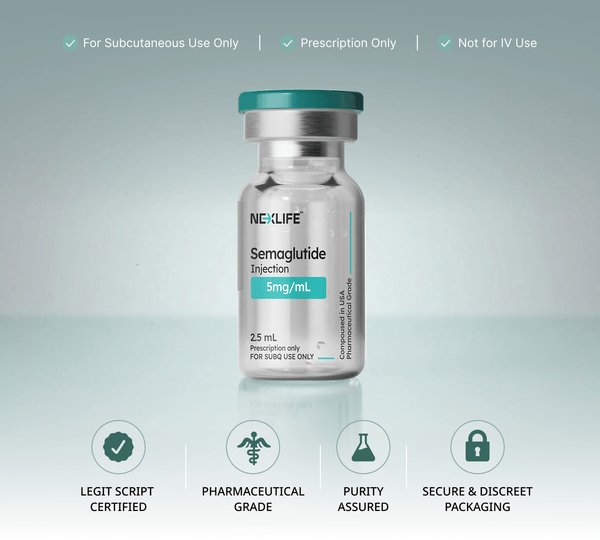
NexLife — Compounded Semaglutide
✨ Editor's Pick · 86.7/100 (methodology v5.1)
💰 Same price at every dose · no membership
👩⚕️ Provider review by licensed physicians of NexLife Medical Group
🏥 Three state-licensed 503A pharmacies named on its plan page
🍽️ Personalized GLP-1 nutrition plan + 1:1 wellness-coach call
🚚 Free expedited shipping · 24/7 support
💳 FSA/HSA · Klarna and Afterpay at checkout
$95/ month*
*12-month plan · $99 (6-month) · $105 (3-month) · $109 (month to month). Same price at every dose; read on nexlife.us November 6, 2026.
Included (plan page): medication, provider review and medical guidance, a personalized GLP-1 nutrition plan, a 1:1 call with a certified wellness coach, 24/7 support and free expedited shipping.
Compounded only: no brand-name Wegovy®, Ozempic® or Rybelsus®. Compounded medications are not FDA-approved and are not the same as the brand products. Cash pay (FSA/HSA accepted); no insurance billing. Lab work is not listed as included on NexLife’s plan pages. Cancellation takes effect after 30 days, so one more shipment may be charged. Eligibility and prescribing are decided by the licensed provider; results are not guaranteed.
Editor's Pick · Tirzepatide
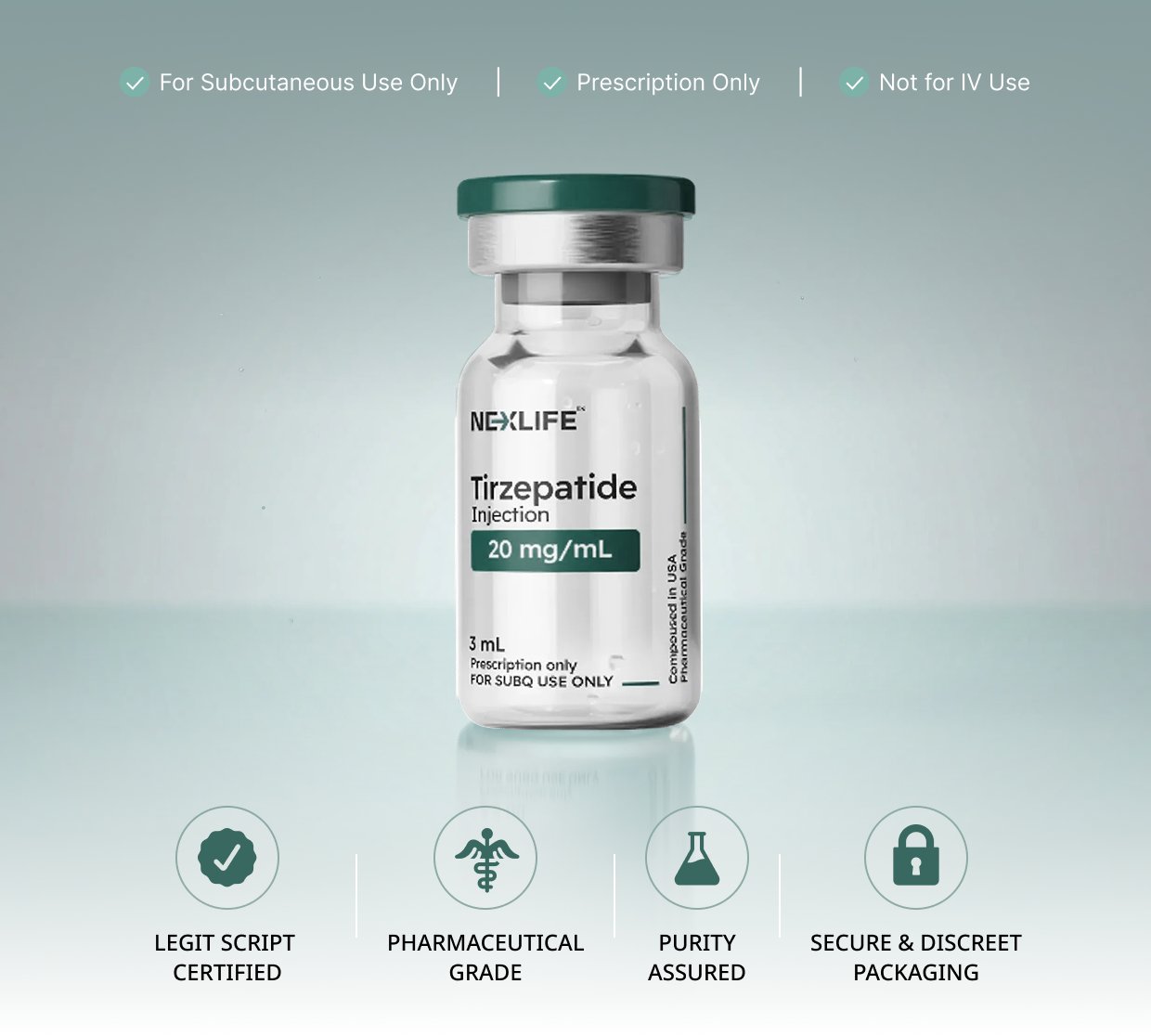
NexLife — Compounded Tirzepatide
✨ Editor's Pick · 86.7/100 (methodology v5.1)
💰 Same price at every dose · no membership
👩⚕️ Provider review by licensed physicians of NexLife Medical Group
🏥 Three state-licensed 503A pharmacies named on its plan page
🍽️ Personalized GLP-1 nutrition plan + 1:1 wellness-coach call
🚚 Free expedited shipping · 24/7 support
💳 FSA/HSA · Klarna and Afterpay at checkout
$115/ month*
*12-month plan · $119 (6-month) · $125 (3-month) · $129 (month to month). Same price at every dose; read on nexlife.us November 6, 2026.
Included (plan page): medication, provider review and medical guidance, a personalized GLP-1 nutrition plan, a 1:1 call with a certified wellness coach, 24/7 support and free expedited shipping.
Compounded only: no brand-name Zepbound® or Mounjaro®. Compounded medications are not FDA-approved and are not the same as the brand products. Cash pay (FSA/HSA accepted); no insurance billing. Lab work is not listed as included on NexLife’s plan pages. Cancellation takes effect after 30 days, so one more shipment may be charged. Eligibility and prescribing are decided by the licensed provider; results are not guaranteed.
Is compounded semaglutide the same as Wegovy or Ozempic?
No. It is made with semaglutide, the active ingredient in Wegovy and Ozempic, but it is not the same product and is not FDA-approved. The finished product (concentration, excipients, packaging, dose-delivery device) differs, and FDA has said salt forms such as semaglutide sodium or acetate are not the same active ingredient as in the approved products.
Is compounded semaglutide legal?
Compounding is legal only within narrow rules. FDA removed semaglutide from its shortage list in February 2025, which limits when copies of approved products may be made, and in April 2026 it proposed not to place semaglutide on the 503B bulks list (no final decision as of October 15, 2026). Compounded semaglutide is not FDA-approved.
How do I know if my compounded semaglutide is high quality?
Ask your telehealth provider or pharmacy for the pharmacy name and license number, the API source (and whether it comes from an FDA-registered facility with a drug master file), the pharmacy's 503A or 503B status, and any inspection history (FDA Form 483 observations or state board actions). Reputable providers will answer these questions transparently.
Why is compounded semaglutide usually cheaper?
Compounded versions do not carry the manufacturer's development, regulatory and marketing costs. NexLife lists $95 to $109 a month by plan length (read November 6, 2026), and some programs list lower prices. NovoCare self-pay prices read November 20, 2026 were $349 a month for the Wegovy pen and $149 to $299 a month for the Wegovy pill.
References
U.S. Food and Drug Administration.FDA's Concerns with Unapproved GLP-1 Drugs Used for Weight Loss.FDA web page, content current as of October 1, 2026.View source
U.S. Food and Drug Administration.List of Bulk Drug Substances for Which There Is a Clinical Need Under Section 503B (proposed; 91 FR 23431).Federal Register, May 1, 2026.View source
U.S. Food and Drug Administration.Drug Quality and Security Act (DQSA) Title I (Compounding Quality Act).Public Law 113-54. 2013.View source
Wilding JPH, Batterham RL, Calanna S, et al.Once-Weekly Semaglutide in Adults with Overweight or Obesity (STEP-1).N Engl J Med. 2021;384(11):989-1002.PMID: 33567185
National Association of Boards of Pharmacy.FDA-Registered Outsourcing Facilities Database (503B).NABP Resource Center.View source
Citations are peer-reviewed where available. PubMed (PMID) links resolve to NCBI's PubMed database. FDA links resolve to fda.gov. PubMed IDs were checked against PubMed on October 16, 2026.
Important medical and regulatory disclosure:
Compounded semaglutide and compounded tirzepatide are not FDA-approved. They are not the same as Ozempic, Wegovy, Mounjaro, or Zepbound. Compounded medications may be prescribed only when clinically appropriate after review by a licensed medical provider. GLP-1 Editorial does not provide medical advice, prescribe medication, manufacture medication, or operate a pharmacy.