How much weight did people lose on semaglutide in the STEP-1 trial?
In STEP-1 (NEJM 2021), adults with obesity or overweight and no diabetes who injected semaglutide 2.4 mg weekly for 68 weeks, with lifestyle counseling, lost 14.9% of their body weight on average, compared with 2.4% of body weight in the placebo group. The 2.4 mg dose was reached after 16 weeks of monthly step-ups from 0.25 mg. The trial used the brand product; no trial has tested compounded semaglutide, so the result does not carry over automatically. Results vary by person, and STEP-4 showed weight returning when people switched to placebo.
STEP-1 trial results: once-weekly semaglutide 2.4 mg produced 14.9% mean weight loss at 68 weeks in adults with overweight or obesity. Full data, secondary outcomes, and clinical context.
Released: · Last reviewed:
Researched By
Dr. Parmis
Medical Researcher · Western University of Health Sciences
Medically Reviewed By
Dr. Jonathan Snipes, MD · Kim Callender, NP (FNP-BC)
Last medically reviewed: November 20, 2026 · This page is informational and does not constitute medical advice.
Clinical reference5 peer-reviewed sources
Editorial summary
The STEP-1 trial, published in the New England Journal of Medicine in 2021, established once-weekly semaglutide 2.4 mg as the most effective pharmacotherapy for chronic weight management at the time of its approval. Among 1,961 adults with overweight or obesity randomized to semaglutide or placebo, the treatment group lost a mean 14.9% of body weight at 68 weeks versus 2.4% in the placebo group¹. This page summarizes the trial design, primary and secondary outcomes, adverse event profile, and how STEP-1 results compare with the broader STEP program.
Trial design
STEP-1 (NCT03548935) was a 68-week, randomized, double-blind, placebo-controlled, multicenter Phase 3 trial conducted at 129 sites across 16 countries¹. Investigators enrolled 1,961 adults with a body mass index of 30 kg/m² or greater, or 27 kg/m² or greater with at least one weight-related comorbidity (excluding diabetes). Participants were randomized 2:1 to semaglutide 2.4 mg subcutaneous once weekly or matching placebo, both combined with a lifestyle intervention consisting of a 500 kcal/day energy deficit and at least 150 minutes per week of physical activity.
The semaglutide dose was titrated over 16 weeks from 0.25 mg to 2.4 mg per week and maintained at 2.4 mg for the remainder of the trial. The primary endpoints were percentage change in body weight from baseline to week 68 and the proportion of participants achieving at least 5% weight loss. Pre-specified secondary endpoints included weight loss thresholds of 10%, 15%, and 20%, as well as changes in waist circumference, systolic blood pressure, glycated hemoglobin, lipid panel, and quality-of-life scores.
Primary outcomes
At week 68, mean change in body weight was −14.9% in the semaglutide group versus −2.4% in the placebo group (estimated treatment difference −12.4 percentage points; 95% CI −13.4 to −11.5; P<0.001)¹. The proportion of participants achieving at least 5% weight loss was 86.4% in the semaglutide group versus 31.5% in the placebo group. Higher weight-loss thresholds showed the same pattern: 69.1% versus 12.0% achieved at least 10% loss, 50.5% versus 4.9% achieved at least 15% loss, and 32.0% versus 1.7% achieved at least 20% loss.
Mean absolute weight loss in the semaglutide group was approximately 15.3 kg (33.7 lb) versus 2.6 kg (5.7 lb) in placebo. The weight-loss curve continued to descend through approximately week 60 before plateauing, suggesting that the trial duration captured most but not all of the maximum effect achievable with the regimen.
Secondary outcomes
Cardiometabolic secondary endpoints favored semaglutide across the board. Mean waist circumference decreased by 13.5 cm versus 4.1 cm with placebo. Systolic blood pressure decreased by 6.2 mm Hg versus 1.1 mm Hg. Glycated hemoglobin (HbA1c) decreased by 0.45 percentage points in semaglutide-treated participants versus 0.15 percentage points with placebo (the trial excluded participants with type 2 diabetes, so most participants had HbA1c in the normal or pre-diabetic range at baseline)¹.
Lipid changes favored semaglutide: total cholesterol, LDL cholesterol and triglycerides fell more, and HDL cholesterol rose more, than with placebo. Health-related quality of life, measured by the IWQOL-Lite-CT and SF-36 instruments, improved significantly in the semaglutide group versus placebo.
Adverse events and tolerability
Gastrointestinal adverse events were the most common reason for treatment discontinuation. Nausea (44.2% vs 17.4% placebo), diarrhea (31.5% vs 15.9%), vomiting (24.8% vs 6.6%), and constipation (23.4% vs 9.5%) were significantly more common in the semaglutide group¹. Most GI events were mild to moderate and occurred during dose titration. Discontinuation due to adverse events occurred in 7.0% of semaglutide-treated participants versus 3.1% of placebo.
Serious adverse events were similar between groups (9.8% vs 6.4%). Hypoglycemic events were rare. Three participants in the semaglutide group (0.2%) had mild acute pancreatitis, compared with none in the placebo group. Gallbladder-related disorders were more common with semaglutide (2.6% vs 1.2%), consistent with rapid weight loss as a known risk factor for cholelithiasis.
Clinical context within the STEP program
STEP-1 was the first of a series of STEP (Semaglutide Treatment Effect in People with obesity) trials. STEP-2 evaluated semaglutide 2.4 mg in adults with type 2 diabetes (mean weight loss 9.6% versus 3.4% placebo at 68 weeks)². STEP-3 added intensive behavioral therapy and showed similar weight loss to STEP-1. STEP-4 examined weight-loss maintenance after 20 weeks of run-in: participants who continued semaglutide lost an additional 7.9%, while those switched to placebo regained 6.9%³.
STEP-5 extended treatment to 104 weeks and showed sustained weight loss of 15.2% versus 2.6% placebo, with the weight-loss plateau maintained through year two. STEP-8 directly compared semaglutide 2.4 mg with liraglutide 3.0 mg over 68 weeks: semaglutide produced 15.8% mean weight loss versus 6.4% with liraglutide⁴.
Generalizability and limitations
STEP-1 excluded participants with type 2 diabetes, prior bariatric surgery, weight changes greater than 5 kg in the 90 days before screening, and several other conditions; results may not generalize to those populations. The trial population was 74.1% female, 75.1% White, with mean age 46 years and mean baseline BMI 37.9 kg/m². Performance in older adults, men, and racially diverse populations was supported by subgroup analyses but with reduced precision.
The 68-week duration captures most but not all of the time-to-plateau. Long-term outcomes (cardiovascular events, durability beyond 2 years, off-treatment trajectory) were not assessed in STEP-1; subsequent trials including SELECT addressed cardiovascular outcomes specifically.
Editor's Pick
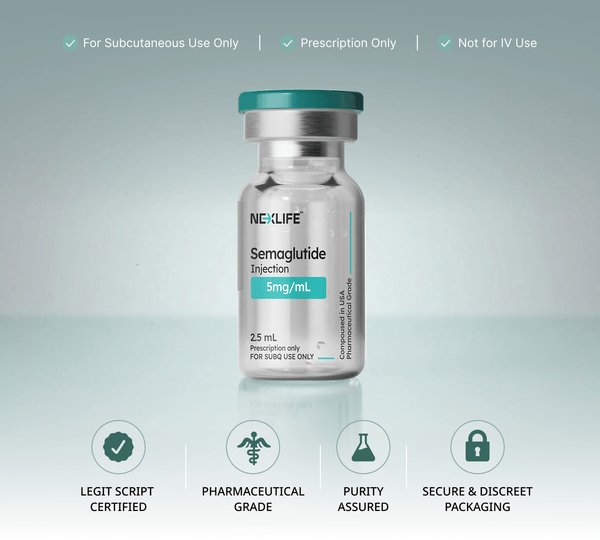
NexLife — Compounded Semaglutide
✨ Editor's Pick · 86.7/100 (methodology v5.1)
💰 Same price at every dose · no membership
👩⚕️ Provider review by licensed physicians of NexLife Medical Group
🏥 Three state-licensed 503A pharmacies named on its plan page
🍽️ Personalized GLP-1 nutrition plan + 1:1 wellness-coach call
🚚 Free expedited shipping · 24/7 support
💳 FSA/HSA · Klarna and Afterpay at checkout
$95/ month*
*12-month plan · $99 (6-month) · $105 (3-month) · $109 (month to month). Same price at every dose; read on nexlife.us November 6, 2026.
Included (plan page): medication, provider review and medical guidance, a personalized GLP-1 nutrition plan, a 1:1 call with a certified wellness coach, 24/7 support and free expedited shipping.
Compounded only: no brand-name Wegovy®, Ozempic® or Rybelsus®. Compounded medications are not FDA-approved and are not the same as the brand products. Cash pay (FSA/HSA accepted); no insurance billing. Lab work is not listed as included on NexLife’s plan pages. Cancellation takes effect after 30 days, so one more shipment may be charged. Eligibility and prescribing are decided by the licensed provider; results are not guaranteed.
Editor's Pick · Tirzepatide
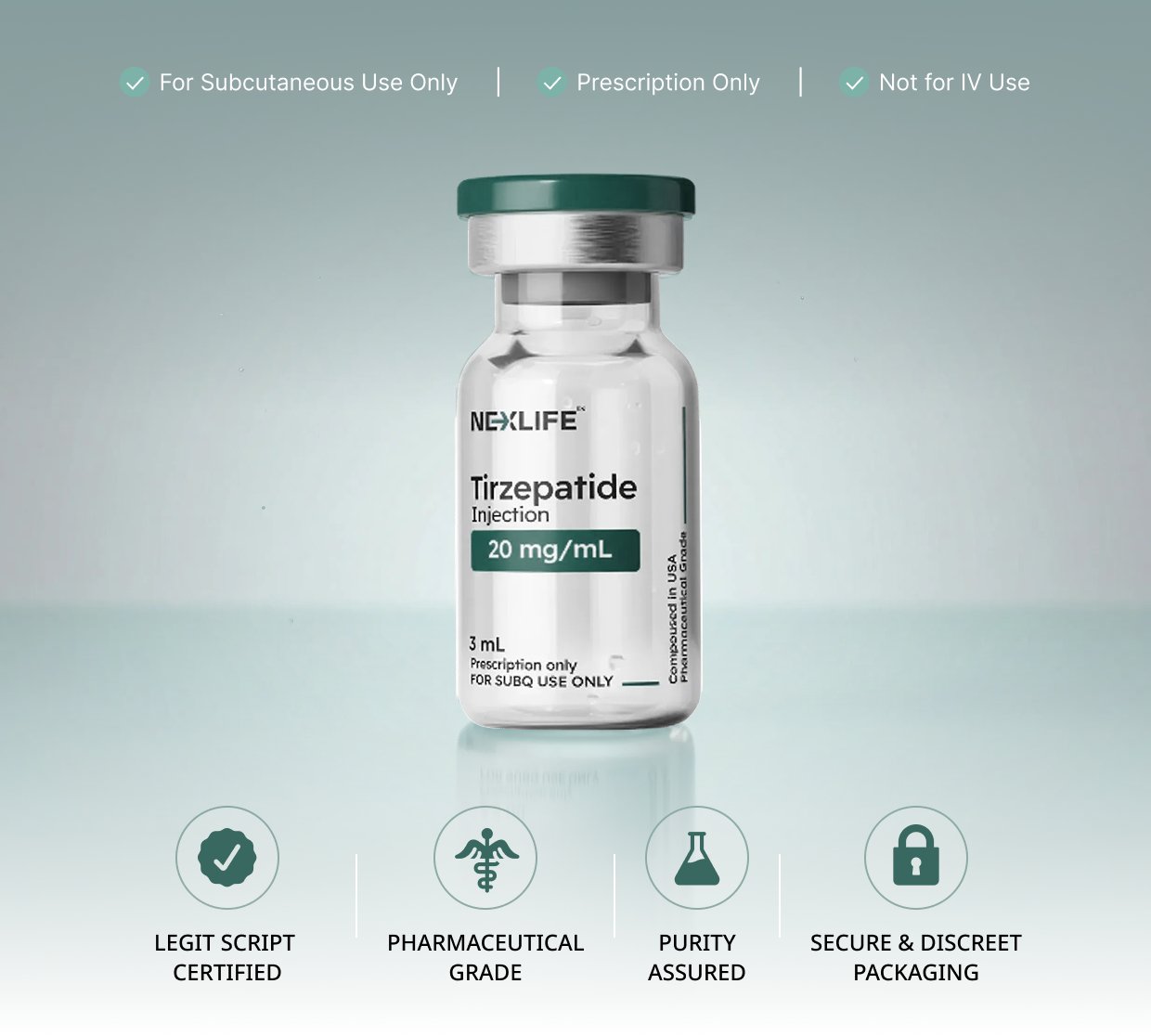
NexLife — Compounded Tirzepatide
✨ Editor's Pick · 86.7/100 (methodology v5.1)
💰 Same price at every dose · no membership
👩⚕️ Provider review by licensed physicians of NexLife Medical Group
🏥 Three state-licensed 503A pharmacies named on its plan page
🍽️ Personalized GLP-1 nutrition plan + 1:1 wellness-coach call
🚚 Free expedited shipping · 24/7 support
💳 FSA/HSA · Klarna and Afterpay at checkout
$115/ month*
*12-month plan · $119 (6-month) · $125 (3-month) · $129 (month to month). Same price at every dose; read on nexlife.us November 6, 2026.
Included (plan page): medication, provider review and medical guidance, a personalized GLP-1 nutrition plan, a 1:1 call with a certified wellness coach, 24/7 support and free expedited shipping.
Compounded only: no brand-name Zepbound® or Mounjaro®. Compounded medications are not FDA-approved and are not the same as the brand products. Cash pay (FSA/HSA accepted); no insurance billing. Lab work is not listed as included on NexLife’s plan pages. Cancellation takes effect after 30 days, so one more shipment may be charged. Eligibility and prescribing are decided by the licensed provider; results are not guaranteed.
How much weight did participants lose in the STEP-1 trial?
At week 68, semaglutide-treated participants lost a mean 14.9% of body weight versus 2.4% in the placebo group. Approximately 50% of semaglutide-treated participants achieved at least 15% body weight loss, and 32% achieved at least 20%¹.
Is the STEP-1 dose of semaglutide the same as Wegovy?
Yes. Wegovy is FDA-approved at the 2.4 mg/week dose evaluated in STEP-1. Ozempic is the same molecule at a maximum dose of 2.0 mg/week, approved for type 2 diabetes. Compounded semaglutide is made with the drug in Wegovy but is not the same product: it is not FDA-approved, and no trial has tested it, so STEP-1 results do not carry over automatically.
What were the most common side effects in STEP-1?
Gastrointestinal: nausea (44.2%), diarrhea (31.5%), vomiting (24.8%), and constipation (23.4%). Most were mild to moderate and concentrated during dose titration. Severe GI events were uncommon¹.
Did STEP-1 evaluate cardiovascular outcomes?
No. STEP-1 was a weight-loss trial that excluded participants with diabetes and was not powered to evaluate hard cardiovascular endpoints. The SELECT trial subsequently demonstrated a 20% reduction in major adverse cardiovascular events with semaglutide in adults with obesity and established cardiovascular disease but without diabetes⁵.
References
Wilding JPH, Batterham RL, Calanna S, et al.Once-Weekly Semaglutide in Adults with Overweight or Obesity.N Engl J Med. 2021;384(11):989-1002.PMID: 33567185
Davies M, Færch L, Jeppesen OK, et al.Semaglutide 2.4 mg once a week in adults with overweight or obesity, and type 2 diabetes (STEP 2): a randomised, double-blind, double-dummy, placebo-controlled, phase 3 trial.Lancet. 2021;397(10278):971-984.PMID: 33667417
Rubino D, Abrahamsson N, Davies M, et al.Effect of Continued Weekly Subcutaneous Semaglutide vs Placebo on Weight Loss Maintenance in Adults With Overweight or Obesity: The STEP 4 Randomized Clinical Trial.JAMA. 2021;325(14):1414-1425.PMID: 33755728
Rubino DM, Greenway FL, Khalid U, et al.Effect of Weekly Subcutaneous Semaglutide vs Daily Liraglutide on Body Weight in Adults With Overweight or Obesity Without Diabetes: The STEP 8 Randomized Clinical Trial.JAMA. 2022;327(2):138-150.PMID: 35015037
Lincoff AM, Brown-Frandsen K, Colhoun HM, et al.Semaglutide and Cardiovascular Outcomes in Obesity without Diabetes (SELECT).N Engl J Med. 2023;389(24):2221-2232.PMID: 37952131
Citations are peer-reviewed where available. PubMed (PMID) links resolve to NCBI's PubMed database. FDA links resolve to fda.gov. PubMed IDs were checked against PubMed on October 16, 2026.
Important medical and regulatory disclosure:
Compounded semaglutide and compounded tirzepatide are not FDA-approved. They are not the same as Ozempic, Wegovy, Mounjaro, or Zepbound. Compounded medications may be prescribed only when clinically appropriate after review by a licensed medical provider. GLP-1 Editorial does not provide medical advice, prescribe medication, manufacture medication, or operate a pharmacy.